 Image credit: Unsplash
Abstract
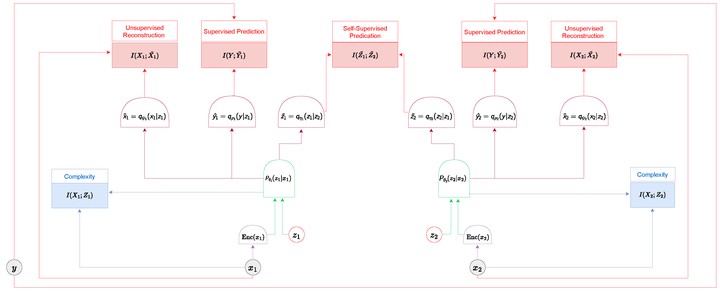
Deep neural networks excel in supervised learning tasks but are constrained by the need for extensive labeled data. Self-supervised learning emerges as a promising alternative, allowing models to learn without explicit labels. Information theory has shaped deep neural networks, particularly the information bottleneck principle. This principle optimizes the trade-off between compression and preserving relevant information, providing a foundation for efficient network design in supervised contexts. However, its precise role and adaptation in self-supervised learning remain unclear. In this work, we scrutinize various self-supervised learning approaches from an information-theoretic perspective, introducing a unified framework that encapsulates the self-supervised information-theoretic learning problem. This framework includes multiple encoders and decoders, suggesting that all existing work on self-supervised learning can be seen as specific instances. We aim to unify these approaches to understand their underlying principles better and address the main challenge: many works present different frameworks with differing theories that may seem contradictory. By weaving existing research into a cohesive narrative, we delve into contemporary self-supervised methodologies, spotlight potential research areas, and highlight inherent challenges.

Ravid Shwartz Ziv
AI Researcher
AI researcher at Meta MSL with a background in information theory and computational neuroscience, working on world models, memory, and compression. Former Assistant Professor and Faculty Fellow at NYU. My industry experience spans Wand AI, Intel, Google AI, and Wikipedia.